- Get in Touch with Us

Last Updated: Apr 25, 2025 | Study Period: 2020-2027
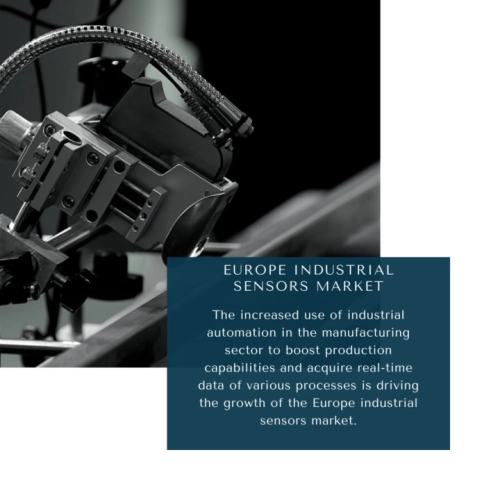
The increased use of industrial automation in the manufacturing sector to boost production capabilities and acquire real-time data of various processes is driving the growth of the Europe industrial sensors market.
The worldwide industrial sensors market has grown significantly over the years as demand for smart factories has increased. Market participants use industrial sensors to monitor and respond to physical environment inputs.
Gas, location, pressure, picture humidity, motion, level, flow, force, and temperature are among the inputs. Oil and gas, pharmaceutical, chemical, mining, and energy and power sectors all use such sensors.
Recently, it has been found that non contact industrial sensors are in high demand, consequently propelling the industrial sensors market expansion. The increasing prevalence of wireless sensing and remote sensing adds to the growth of the noncontact sensors market.
In addition, the integration of cloud computing technologies with industrial sensors to provide improved outcomes for manufacturing facilities and the environment would boost global market demand.
The EUROPE INDUSTRIAL SENSORS MARKET accounted for $XX Billion in 2021 and is anticipated to reach $XX Billion by 2026, registering a CAGR of XX% from 2022 to 2027.
As barometric pressure sensors demonstrate their use in an increasing variety of applications, there is a rising demand for more compact, durable, waterproof sensors that are immune to external disturbances.
Rohm Semiconductor has newly announced the BM1390GLV-Z, a waterproof piezoresistive MEMS-based barometric pressure sensor. The atmospheric air pressure is measured with a barometric pressure sensor.
According to Rohm, piezo-resistive pressure sensors use a single Si crystal plate as a diaphragm and diffuse impurities on its surface to form a resistive bridge circuit, allowing pressure (atmospheric) to be calculated by detecting the resistance change caused by the distortion of this resistive bridge when pressure is applied.
Their barometric pressure sensor is an ASIC that includes a pressure-receiving device and a temperature correction element.
| Sl no | Topic |
| 1 | Market Segmentation |
| 2 | Scope of the report |
| 3 | Abbreviations |
| 4 | Research Methodology |
| 5 | Executive Summary |
| 6 | Introduction |
| 7 | Insights from Industry stakeholders |
| 8 | Cost breakdown of Product by sub-components and average profit margin |
| 9 | Disruptive innovation in the Industry |
| 10 | Technology trends in the Industry |
| 11 | Consumer trends in the industry |
| 12 | Recent Production Milestones |
| 13 | Component Manufacturing in US, EU and China |
| 14 | COVID-19 impact on overall market |
| 15 | COVID-19 impact on Production of components |
| 16 | COVID-19 impact on Point of sale |
| 17 | Market Segmentation, Dynamics and Forecast by Geography, 2022-2027 |
| 18 | Market Segmentation, Dynamics and Forecast by Product Type, 2022-2027 |
| 19 | Market Segmentation, Dynamics and Forecast by Application, 2022-2027 |
| 20 | Market Segmentation, Dynamics and Forecast by End use, 2022-2027 |
| 21 | Product installation rate by OEM, 2022 |
| 22 | Incline/Decline in Average B-2-B selling price in past 5 years |
| 23 | Competition from substitute products |
| 24 | Gross margin and average profitability of suppliers |
| 25 | New product development in past 12 months |
| 26 | M&A in past 12 months |
| 27 | Growth strategy of leading players |
| 28 | Market share of vendors, 2022 |
| 29 | Company Profiles |
| 30 | Unmet needs and opportunity for new suppliers |
| 31 | Conclusion |
| 32 | Appendix |


© 2017-2026 Mobility Foresights Admin Pvt Ltd. All rights reserved.