
- Get in Touch with Us

Last Updated: Apr 25, 2025 | Study Period: 2022-2027
The phrase "packaging automation" refers to the packaging process that does not rely on people. It's a brilliant method for removing unnecessary occupations and assisting manufacturing or packaging companies in accomplishing more tasks with fewer people.
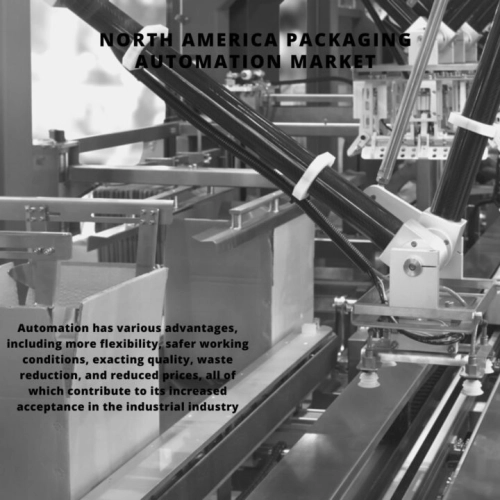
Packing automation decreases the need for human labour, increases packing repeatability and efficiency, and allows for more effective floor space utilisation.
Automation has various advantages, including more flexibility, safer working conditions, exacting quality, waste reduction, and reduced prices, all of which contribute to its increased acceptance in the industrial industry.
Furthermore, based on the needs of product labelling and presentation, the installation of the programming feature in these machines provides variety and non-repetitiveness of duties and activities.
The demand for durable packaging solutions to ensure the durability and endurance of items during transit has increased as disposable incomes have increased along with the level of living.
The North America Packaging Automation Market accounted for $XX Billion in 2021 and is anticipated to reach $XX Billion by 2026, registering a CAGR of XX% from 2022 to 2027.
Emerson has announced new heat staking technology that allows manufacturers to link more complicated, fragile, and sensitive components to plastic mouldings, giving them more design freedom.
The Branson GPX platform offers high-quality joins, improved product aesthetics, and energy savings in increasingly difficult applications by utilising a unique pulse staking technique that improves the heat staking process.
There has been an increase in difficult heat staking applications involving parts with more complex 3D geometries, closely aligned features, and fragile or heat-sensitive components, such as soldered components or sensors, as well as the use of a greater number of blended, glass-reinforced, chromed, and metallicized plastics.
PulseStaker technology is used in the Branson GPX platform to deliver immediate heating and cooling, as well as customizable cycle durations for optimum, low-energy heat staking.
| Sl no | Topic |
| 1 | Market Segmentation |
| 2 | Scope of the report |
| 3 | Abbreviations |
| 4 | Research Methodology |
| 5 | Executive Summary |
| 6 | Introduction |
| 7 | Insights from Industry stakeholders |
| 8 | Cost breakdown of Product by sub-components and average profit margin |
| 9 | Disruptive innovation in the Industry |
| 10 | Technology trends in the Industry |
| 11 | Consumer trends in the industry |
| 12 | Recent Production Milestones |
| 13 | Component Manufacturing in US, EU and China |
| 14 | COVID-19 impact on overall market |
| 15 | COVID-19 impact on Production of components |
| 16 | COVID-19 impact on Point of sale |
| 17 | Market Segmentation, Dynamics and Forecast by Geography, 2022-2027 |
| 18 | Market Segmentation, Dynamics and Forecast by Product Type, 2022-2027 |
| 19 | Market Segmentation, Dynamics and Forecast by Application, 2022-2027 |
| 20 | Market Segmentation, Dynamics and Forecast by End use, 2022-2027 |
| 21 | Product installation rate by OEM, 2022 |
| 22 | Incline/Decline in Average B-2-B selling price in past 5 years |
| 23 | Competition from substitute products |
| 24 | Gross margin and average profitability of suppliers |
| 25 | New product development in past 12 months |
| 26 | M&A in past 12 months |
| 27 | Growth strategy of leading players |
| 28 | Market share of vendors, 2022 |
| 29 | Company Profiles |
| 30 | Unmet needs and opportunity for new suppliers |
| 31 | Conclusion |
| 32 | Appendix |


© 2017-2026 Mobility Foresights Admin Pvt Ltd. All rights reserved.